Is Phantom Wallet Safe? A Plain 2026 Security Check
Phantom is a sound choice of self-custody wallet for day-to-day Solana and multi-chain use: the company says it never has access to your funds, it scans transactions for known scams before you sign, and it lets you pair a Ledger so the keys sit on separate hardware. It is not a cold wallet, though, and its public evidence is thinner than its marketing suggests. Phantom has published two audit reports, from 2021 and 2024, and its July 2026 privacy policy allows it to link your wallet addresses to your email or username unless you opt out.
In short, it is safe enough as a hot wallet for amounts you could stand to lose, if you keep the habits below; not the place for long-term savings. As with any self-custody app, the larger risks are fake apps, phishing and the approvals you sign, not the wallet's code. Phantom pays us nothing, so this check earns us nothing either way. Everything below was read on Phantom's own pages on 18 October 2026.
Self-custody means nobody can reverse a mistake. Anyone who sees your recovery phrase can empty the wallet, and a signed approval can drain it without the phrase ever leaving your phone. Crypto is volatile, and nothing here is financial advice.
Short answer: what Phantom gets right
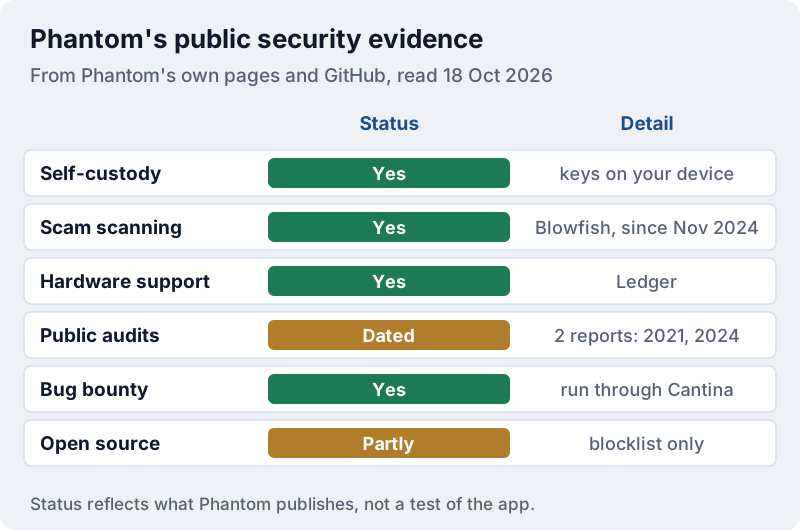
Phantom's security page makes four core promises: self-custody, a readable preview of what you are signing, Ledger support, and scam detection that flags malicious transactions. Phantom's November 2024 announcement that it had acquired Blowfish, a transaction-security company, describes exactly these previews and malicious-site alerts, and credits Blowfish with 2.8 million scams prevented and 1.3 billion transactions scanned; those are Phantom's own figures, not an independent count.
Two smaller features help too. Phantom maintains an open-source blocklist of phishing domains on GitHub, which the wallet uses to warn you away from known bad sites, and it lets you burn the spam NFTs that scammers drop into wallets as bait. Support runs around the clock, according to the same page. None of this makes a hot wallet into a vault, but it is the right set of tools for one.
Where the evidence is thin
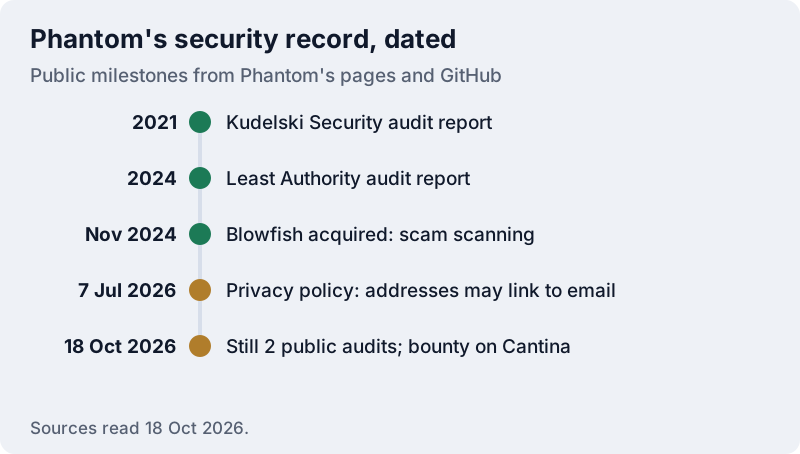
Audits are the first gap. The security page says Phantom's code has been audited by top firms and links to a GitHub repository; on 18 October 2026 that repository held exactly two reports, Kudelski Security from 2021 and Least Authority from 2024. Phantom has added features since then, including the payment features its privacy policy now covers, and no public report covers that newer code. An audit is a snapshot of one scope at one moment, so the date matters as much as the auditor's name.
Open source is the second. Phantom calls its blocklist open source, but the security page does not describe the wallet app itself that way, so outsiders cannot inspect how it handles your keys. Compare that with wallets that publish their core libraries. The bug bounty is the third, smaller wrinkle: the security page still advertises rewards of up to $50,000, while the bug bounty page sends researchers to a programme on Cantina for current scope and rewards. Neither is alarming; both are reasons not to treat the marketing page as the full story.
| Protection | What it does | What it does not do |
|---|---|---|
| Self-custody | Keys are created and stored on your device; Phantom says it never has access | Protect a recovery phrase you type into a fake site |
| Transaction preview and scam scanner | Flags known malicious transactions before you sign | Catch a new scam it has not seen, or stop you signing anyway |
| Phishing blocklist | Warns on known bad domains; the list is open source | Cover a fresh lookalike domain registered today |
| Ledger pairing | Keeps keys on separate hardware; signing needs the device | Stop you approving a harmful transaction on that device |
| Bug bounty | Pays researchers to report flaws, now through Cantina | Guarantee that flaws are found before attackers find them |
Phantom's privacy policy: the catch worth knowing
Phantom's security page says it never tracks personally identifiable information or asset balances. Its privacy policy, last updated 7 July 2026, is more nuanced. It says Phantom may associate your wallet addresses with account identifiers, such as your email address or username, for support, fraud detection and a consistent experience across features, and that you can opt out in the app's settings, although doing so may limit some support and fraud protection. It also processes your IP address for security and to derive an approximate location.
If you use Phantom Cash or other payment features, the policy says Phantom collects the last four digits of your bank account and payment cards. None of this gives Phantom control of your coins. It does mean that a wallet you think of as anonymous can be tied to your identity inside Phantom's systems. If that matters to you, find the opt-out in settings, and keep wallets you use for payments separate from those you do not want linked.
Is Phantom a cold wallet?
No. Phantom is a hot wallet: an app or browser extension on a device that is online, so the key is decrypted on a general-purpose phone or computer every time you sign. You can make it work like the front end of a cold wallet by connecting a Ledger, which Phantom's security page supports; then the key stays on the Ledger and every signature needs a press on the device. That is the right move once a balance would hurt to lose. Our guide on hot vs cold wallets sets out the trade-off in full.
If you take that route, Ledger is the hardware Phantom names, and you can compare Ledger's devices on its own shop; that is an affiliate link, and Phantom pays us nothing either way. A hardware device does not stop you approving a malicious transaction, so the reading habits below still apply. For timing and the move itself, see when to move to a hardware wallet.
Phantom scams: fake apps, fake support, drainers
The common losses do not come through Phantom's code. Fake apps and extensions are the cheapest trick, so install only from the links on phantom.com's download page, which links the extension's Chrome Web Store listing and the iOS and Android apps. Fake support comes next: Phantom says its support is reached through its help centre, and nobody genuine will ask for your recovery phrase or ask you to validate a wallet on a website.
Drainers are the subtler threat. A site presents a harmless-looking request, and signing it hands a contract permission to move your tokens, or signs a transfer outright. Phantom's scanner catches known patterns, but a new contract can slip past. Our guide to wallet drainers and approval scams explains how they work and how to clean up afterwards.
Setting up Phantom safely
- Install only from phantom.com's download page, and check the publisher before you tap install.
- Keep the recovery phrase offline, on paper or a metal plate, and never in a screenshot, notes app or cloud file.
- Read every warning and every signing request, and cancel anything you did not start.
- Revoke app connections you no longer use, and keep separate wallets for experiments and savings.
- Decide on the privacy opt-out for linking addresses to your email or username.
- Pair a Ledger before the balance grows to a sum you would grieve.
Phantom is one of several wallets we compare on security and custody in our best crypto wallets ranking. For the recovery phrase in more depth, see seed-phrase security and scams, and for a wallet with a heavier incident record, our Trust Wallet safety check.
Edge cases
- You signed something odd and tokens left. Move what remains to a new wallet with a new recovery phrase, then revoke approvals on the old one.
- You use the extension and the phone app. Both hold the same keys once you import the phrase, so a compromise of either device exposes both.
- Someone offers to recover a drained wallet for a fee. Confirmed transfers cannot be reversed, and asking for money upfront is the tell.
Is Phantom wallet safe? Common questions
Is Phantom wallet safe?
Is Phantom a cold wallet?
Is Phantom crypto wallet legit?
Can Phantom see my wallet or link it to me?
What should I do if my Phantom wallet was drained?
Next: see how the options stack up in our guide to the best crypto wallets, ranked on security and custody, or read hot wallet vs cold wallet to know when to move to cold storage.